A carbon atom has six protons and six neutrons. Its mass is about 12 atomic mass units. But not all carbon atoms are the same. Carbon-12 has six neutrons. Carbon-13 has seven. Carbon-14 has eight. These are isotopes, atoms of the same element with different numbers of neutrons. Atomic mass is the weighted average mass of an element's atoms, taking into account the abundance of each isotope.
The atomic mass unit is defined as one-twelfth the mass of a carbon-12 atom. It is approximately 1.66 times 10 to the minus 27 kilograms. Protons and neutrons each have a mass close to 1 amu. Electrons are much lighter, about 1/1836 of a proton. The atomic mass of an element is usually close to the mass number of its most abundant isotope, but not exactly, because of the mass defect from binding energy.
Atomic mass matters in chemistry. It is used to calculate molar mass, which is the mass of one mole of a substance. The molar mass of an element in grams per mole is numerically equal to its atomic mass in amu. That relationship makes it possible to convert between mass and moles, which is essential for stoichiometry.
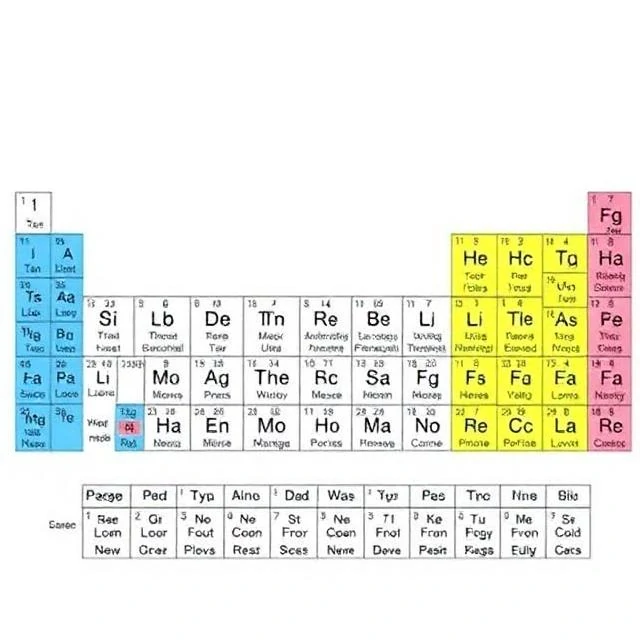
The periodic table lists atomic masses, usually as decimals. The decimal reflects the weighted average of the isotopes. Chlorine, for example, has an atomic mass of 35.45, because it is a mixture of chlorine-35 and chlorine-37.
Comments
No comments yet. Be the first to share a thought.
Leave a comment