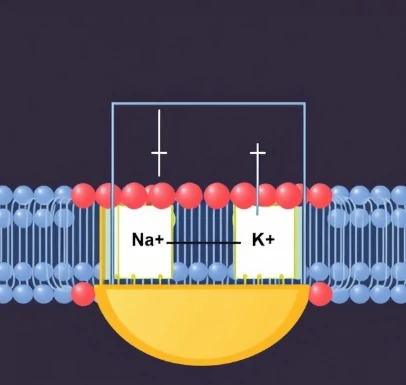
Every neuron continuously expends energy to maintain the ion gradients that make electrical signaling possible. The enzyme responsible is the sodium-potassium pump, or Na+/K+-ATPase, which moves three sodium ions out of the cell and two potassium ions in for each molecule of ATP hydrolyzed.
The resulting gradients power the resting potential, the influx of sodium during action potentials, and many secondary transporters that move neurotransmitters and other solutes. Because the pump is electrogenic—net export of one positive charge per cycle—it also contributes modestly and directly to membrane potential. Its activity is regulated by intracellular sodium levels, phosphorylation, and signaling pathways.
Inhibiting the pump with cardiac glycosides or by energy depletion collapses the gradients, depolarizes the membrane, and ultimately prevents further signaling. The high metabolic cost of the pump is a major reason the brain is so sensitive to interruptions in blood flow or oxygen supply. Understanding pump function is therefore central to both cellular neurophysiology and the pathophysiology of metabolic insults.
Roughly half of the brain’s ATP consumption can be attributed to the activity of this single enzyme.
Comments
No comments yet. Be the first to share a thought.
Leave a comment