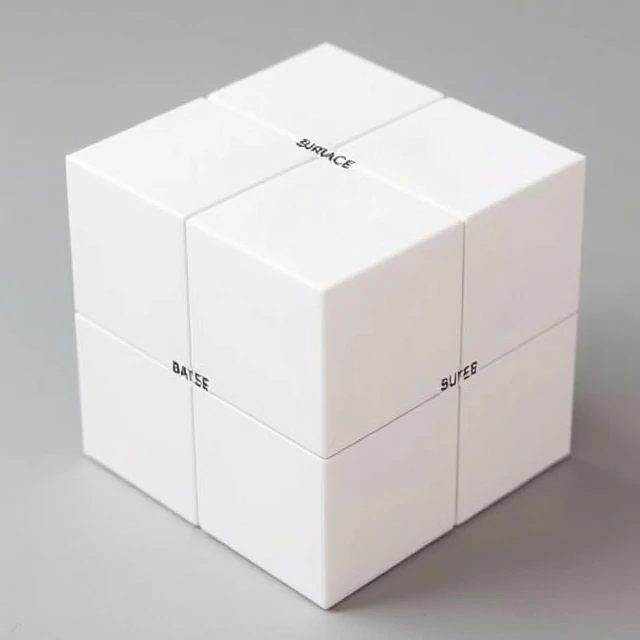
Surface area measures the total area covering a 3D object. For a cube with side s, it is 6s². For a sphere, 4πr². For a cylinder, 2πr² + 2πrh. The units are squared: square meters, square feet.
To find surface area, add the areas of all faces or use a formula. For complex shapes, break the surface into simpler pieces. Nets—flat unfolded versions of 3D shapes—help visualize the calculation.
Surface area matters in painting, wrapping, heat transfer, and chemical reactions. A catalyst's effectiveness depends on its surface area. In biology, cell surface area limits nutrient exchange. The concept connects geometry to real-world applications.
- Total area of a 3D object's surface
- Cube: 6s²; sphere: 4πr²
- Found by adding face areas or using formulas
- Important in painting, heat transfer, and biology
Comments
No comments yet. Be the first to share a thought.
Leave a comment