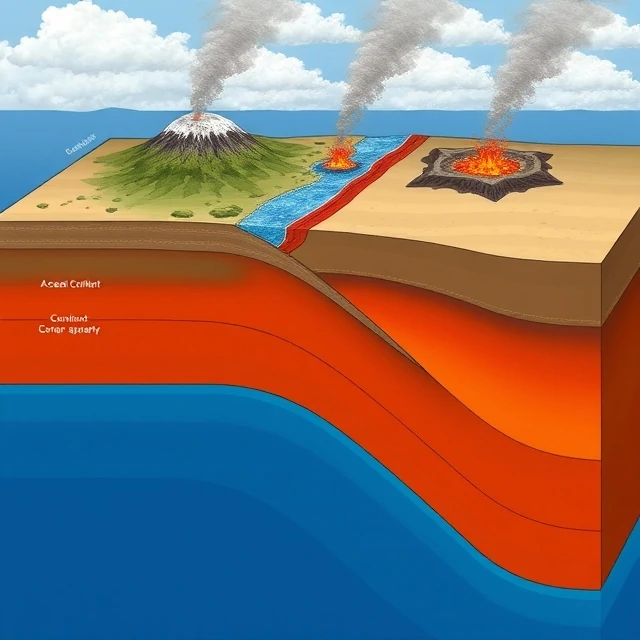
When two tectonic plates move toward each other, the collision zone is called a convergent boundary. One plate usually sinks beneath the other in a process known as subduction, or the plates may crumple upward to form mountain ranges if both are continental.
Ocean-ocean convergence produces volcanic island arcs; ocean-continent convergence builds continental volcanic arcs and deep trenches. Continent-continent collisions create the highest mountain belts, such as the Himalayas. Earthquakes are frequent and can be very deep along the subducting slab.
Convergent boundaries recycle oceanic crust into the mantle and generate new continental crust through magmatism. The Pacific Ring of Fire largely follows these boundaries. Studying them reveals how Earth’s surface constantly renews itself through destruction and creation of lithosphere.
- Plate boundary where plates collide
- Often involves subduction of one plate
- Produces volcanoes, trenches, and mountains
- Site of frequent large earthquakes
Comments
No comments yet. Be the first to share a thought.
Leave a comment