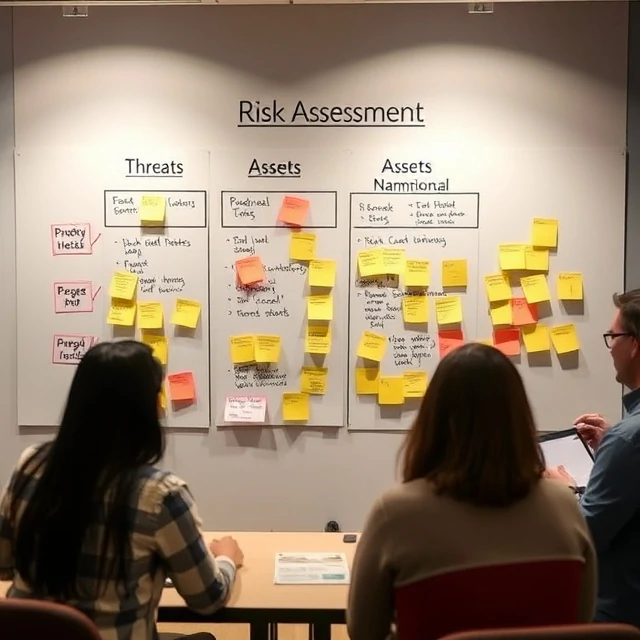
A risk assessment identifies what could go wrong, how likely it is, and what it would cost. It produces a prioritized list of risks so that resources go where they matter most. Without it, security spending is guesswork. With it, decisions have a rationale. A hospital might rank patient data exposure as its top risk. A manufacturer might rank production downtime higher. The ranking depends on the business, not on a generic checklist.
The process starts with asset identification. What are you protecting? Customer data, intellectual property, financial systems, physical infrastructure. Then threat modeling. Who might attack these assets and how? Then vulnerability analysis. What weaknesses exist? Finally, impact and likelihood scoring. A qualitative assessment uses labels like high, medium, and low. A quantitative one assigns dollar values and probabilities. Most organizations use a mix. Qualitative is faster and good enough for prioritization. Quantitative is more defensible when justifying budget. The assessment is not a one-time event. Business changes. New systems appear. Old risks fade. A risk assessment that is two years old is a historical document.
Risk assessment steps
- Identify assets and their value
- Identify threats and threat actors
- Identify vulnerabilities
- Assess likelihood and impact
- Prioritize and document
- Review and update regularly
A risk assessment that nobody acts on is an academic exercise. The value is in the decisions it informs.
Comments
No comments yet. Be the first to share a thought.
Leave a comment