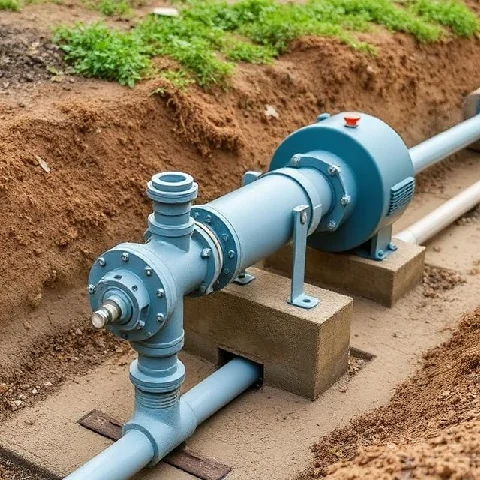
A concrete pump delivers concrete through pipes to a pour site. It is used when the pour location is inaccessible to a truck mixer. A pump can push concrete up to hundreds of meters vertically and horizontally. It can place concrete on a high-rise floor, in a tunnel, or in a foundation pit. The pump is a truck-mounted or trailer-mounted machine with a hopper, a piston or rotor, and a boom or pipeline. The concrete is fed into the hopper, and the pump pushes it through the pipe to the point of placement.
There are two main types of concrete pumps. A boom pump has an articulated boom that can reach over obstacles and place concrete precisely. A line pump uses a pipeline that is assembled on site and can be routed through tight spaces. The choice depends on the access and the volume. A boom pump is faster and more flexible. A line pump is cheaper and can reach places a boom cannot.
Concrete pumping requires careful planning. The mix must be pumpable, meaning it has the right consistency and aggregate size. A mix that is too stiff will clog the pipe. A mix that is too wet will segregate. The pump operator must control the flow and the pressure. A clog can be dangerous. When concrete is pumped, it must be placed and finished quickly. The pump is a tool of speed and precision. It keeps the concrete flowing.
Comments (2)
Leave a comment