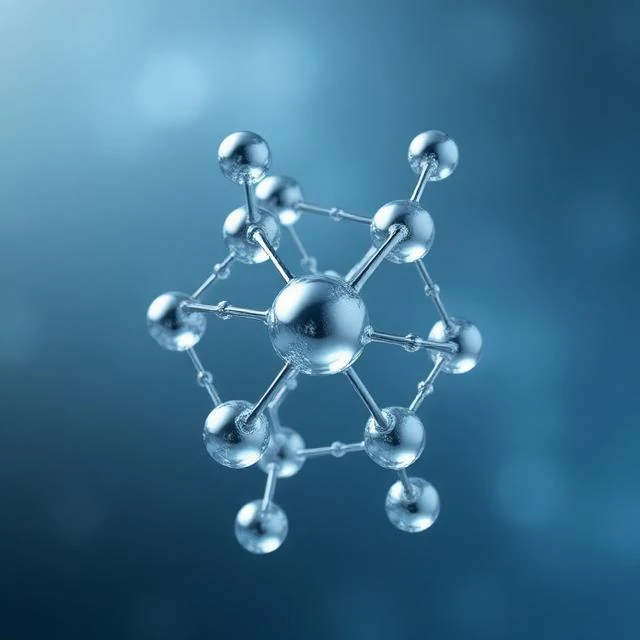
Two hydrogen atoms and one oxygen atom bond together to form water. That is a molecule, a group of two or more atoms bonded together chemically. The atoms can be the same element, like O2, or different elements, like H2O. The molecule is the smallest unit of a covalent compound that retains its chemical properties. It is electrically neutral, unlike an ion.
Molecules vary enormously in size and complexity. Hydrogen is the smallest, with two atoms. Proteins can contain thousands of atoms. DNA can contain billions. The shape of a molecule determines its function. A protein's shape determines what it binds. A drug's shape determines whether it fits its target. Molecular geometry is described by bond lengths, bond angles, and torsion angles. The VSEPR model predicts shapes based on electron repulsion.
Molecules are held together by covalent bonds. They can also interact with each other through weaker forces: hydrogen bonds, dipole-dipole interactions, and London dispersion forces. These intermolecular forces determine boiling points, solubility, and biological activity. They are why water is a liquid at room temperature and methane is a gas.
Molecules are the vocabulary of chemistry. They are what reactions make and break. They are what spectroscopy identifies and what biology uses. The molecule is the fundamental unit of covalent compounds.
Comments
No comments yet. Be the first to share a thought.
Leave a comment