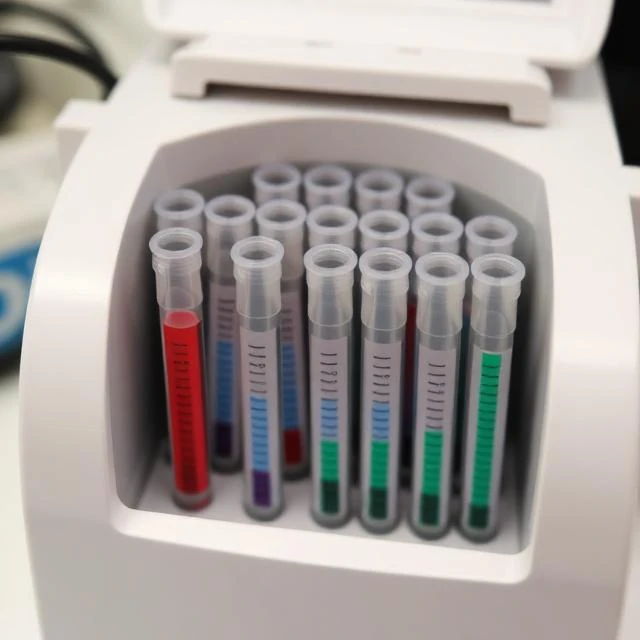
In 1983, Kary Mullis was driving on a California highway when he conceived of a way to copy DNA exponentially. The idea became the polymerase chain reaction, or PCR. It won him the Nobel Prize in 1993. PCR is now one of the most widely used techniques in biology. It can amplify a single copy of DNA into billions of copies in a few hours.
The reaction cycles through three temperatures. Denaturation heats the DNA to about 95 degrees Celsius, separating the double helix into single strands. Annealing cools it to about 50 to 65 degrees, allowing primers to bind to the target sequence. Extension raises it to about 72 degrees, where a heat-stable DNA polymerase, usually Taq, extends the primers and synthesizes new strands. Each cycle doubles the amount of DNA. Thirty cycles produce a billion-fold amplification.
PCR is used for many purposes. It diagnoses infections by detecting pathogen DNA. It amplifies DNA for sequencing and cloning. It detects mutations and genetic disorders. It is used in forensics to analyze DNA from crime scenes. It is used in research to study gene expression and quantify RNA, in a variant called RT-PCR. During the COVID-19 pandemic, PCR testing became a household term.
The technique is simple, fast, and sensitive. It requires careful design of primers, control of contamination, and optimization of conditions. When it works, it turns a tiny sample into enough DNA to analyze. When it fails, it can amplify the wrong sequence or nothing at all.
Comments
No comments yet. Be the first to share a thought.
Leave a comment