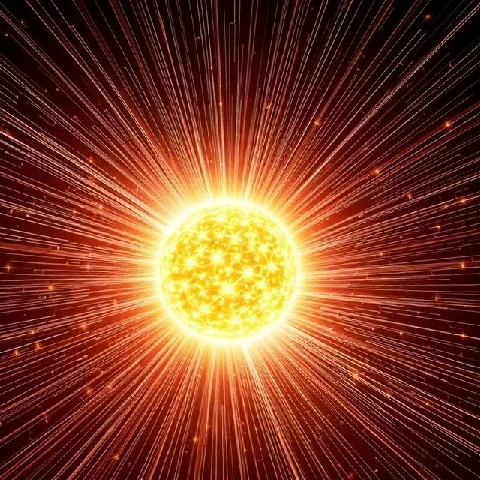
A neutron star is the collapsed core of a massive star that exploded as a supernova. It packs about 1.4 times the mass of the Sun into a sphere roughly 20 kilometers across. That is the density of an atomic nucleus. A teaspoon of neutron star material would weigh billions of tons on Earth.
Neutron stars are made almost entirely of neutrons. The protons and electrons in the original star's core were crushed together, and the resulting neutrons are packed so tightly that they resist further collapse through quantum pressure. The surface is a thin crust of heavier nuclei. The interior may contain exotic states of matter, including superfluid neutrons and superconducting protons.
They spin fast. Conservation of angular momentum during the collapse turns a slowly rotating stellar core into a rapidly spinning neutron star. Some rotate hundreds of times per second. They also have intense magnetic fields, trillions of times stronger than Earth's. When the magnetic field sweeps past Earth, we see a pulse of radio waves. Those are pulsars.
Neutron stars are laboratories for physics. Their gravity is strong enough to bend light noticeably. Their magnetic fields test quantum electrodynamics. Their mergers produce gravitational waves and forge heavy elements like gold and platinum.
Comments
No comments yet. Be the first to share a thought.
Leave a comment