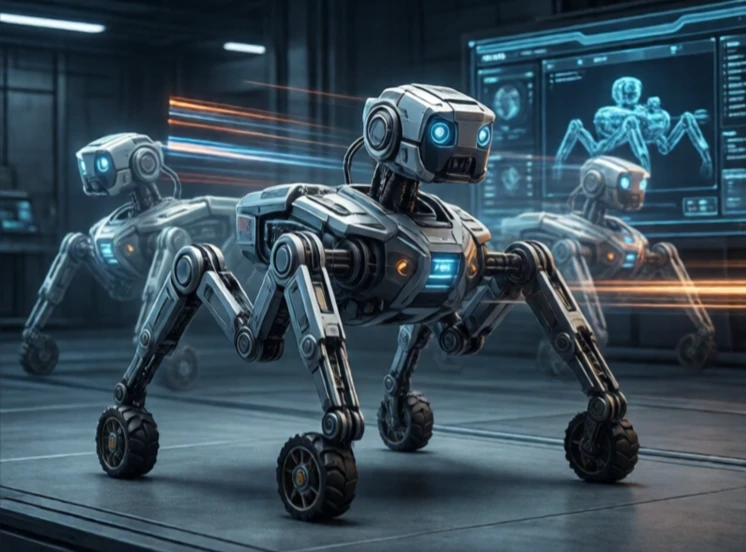
Reinforcement learning trains robots through trial and error. The robot takes actions, receives rewards, and adjusts its behavior to maximize the reward. It is how a dog learns to sit for a treat. The robot does not need labeled examples. It needs a way to measure success.
The framework is a Markov decision process. The robot observes a state, chooses an action, receives a reward, and transitions to a new state. The goal is a policy that maps states to actions to maximize cumulative reward. Deep reinforcement learning uses neural networks to represent the policy and value function. It has solved games like Go and Atari and trained robots to walk, grasp, and fly.
Reinforcement learning challenges
- Sample efficiency: robots need millions of trials.
- Reward design: shaping the right reward is hard.
- Sim-to-real transfer: policies trained in simulation may fail on hardware.
- Safety: exploration can damage the robot.
- Credit assignment: which action led to the reward?
Most reinforcement learning for robots happens in simulation first. The robot practices thousands of lifetimes in a physics engine, then transfers the policy to the real world. Domain randomization, varying friction, mass, and sensor noise in simulation, makes the policy more robust. Even so, the sim-to-real gap remains. A policy that walks perfectly in simulation may fall on real hardware. Researchers use system identification, adaptive control, and residual learning to close the gap. Reinforcement learning is powerful because it can discover solutions that humans would not design. It is also unpredictable. A robot trained with RL might find a clever solution or a dangerous one. Ensuring safety during learning is an open problem.
Comments
No comments yet. Be the first to share a thought.
Leave a comment