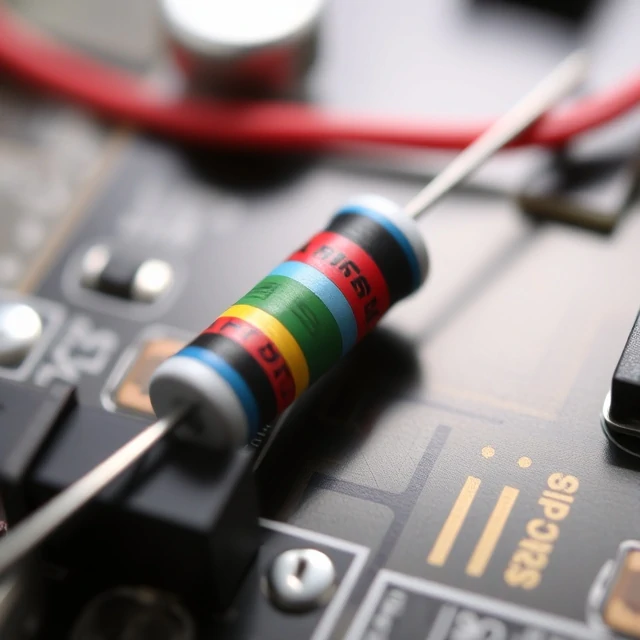
Resistance is the opposition to the flow of electric current. It is measured in ohms. A material with high resistance allows less current to flow for a given voltage. A material with low resistance allows more. Resistance depends on the material, its length, its cross-sectional area, and its temperature. A long, thin wire has more resistance than a short, thick one. Copper has low resistance. Rubber has high resistance. Resistance is what makes wires heat up when current flows through them. It is also what allows resistors to control current in a circuit.
Resistance is described by Ohm's law, which says voltage equals current times resistance. If you know two of the three, you can calculate the third. Resistance is not a flaw. It is a property that makes circuits work. Without resistance, current would be uncontrollable. Resistors are components designed to provide a specific resistance. They come in many values and are marked with color codes. Resistance also appears in other contexts. Air resistance opposes the motion of objects through air. Fluid resistance opposes motion through liquids. Thermal resistance opposes the flow of heat. In each case, resistance is the opposition to flow.
Resistance facts
- Definition. Opposition to electric current.
- Unit. Ohm (Ω).
- Depends on. Material, length, area, temperature.
- Ohm's law. V = IR.
- Resistors. Components with specific resistance.
Resistance is not the same as resistivity. Resistance is a property of a specific object. Resistivity is a property of a material.
Comments
No comments yet. Be the first to share a thought.
Leave a comment