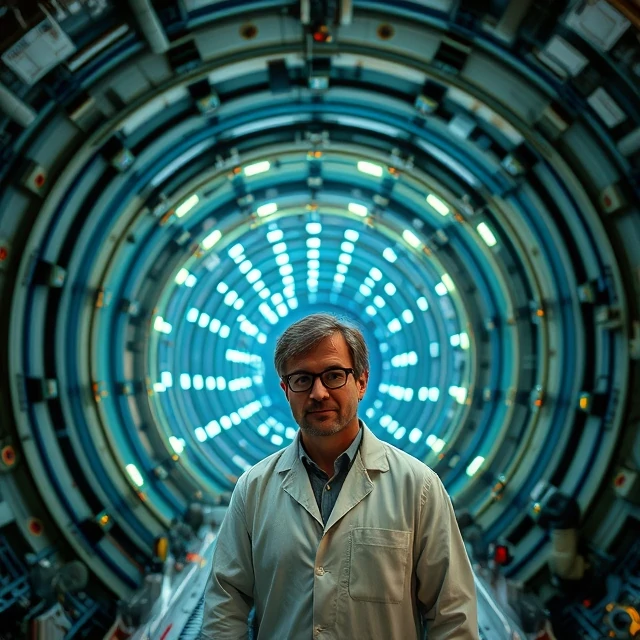
Particle physics studies the fundamental particles and forces that make up the universe. It asks what matter is made of at the smallest scales, and how those particles interact. The field is described by the Standard Model, which includes quarks, leptons, and bosons. Quarks combine to form protons and neutrons. Leptons include electrons and neutrinos. Bosons carry forces. The Higgs boson gives particles mass. The Standard Model is one of the most successful theories in physics, but it is not complete. It does not include gravity, and it does not explain dark matter or dark energy.
Particle physicists use large accelerators to smash particles together at high energies. The Large Hadron Collider at CERN is the most powerful, with a 27-kilometer ring. Detectors the size of buildings record the debris from collisions. By analyzing the debris, physicists discover new particles and test theories. The discovery of the Higgs boson in 2012 was a triumph of the field. Current research focuses on supersymmetry, dark matter candidates, and the properties of neutrinos. Particle physics is expensive and international. It requires collaboration across countries and decades. But it answers some of the deepest questions about the nature of reality.
Particle physics facts
- Standard Model. Quarks, leptons, bosons.
- Accelerators. Large Hadron Collider, 27 km ring.
- Detectors. Record collision debris.
- Higgs boson. Discovered in 2012.
- Open questions. Dark matter, dark energy, gravity.
Particle physics is not the same as nuclear physics. Nuclear physics studies atomic nuclei. Particle physics studies the particles that make up nuclei and everything else.
Comments
No comments yet. Be the first to share a thought.
Leave a comment