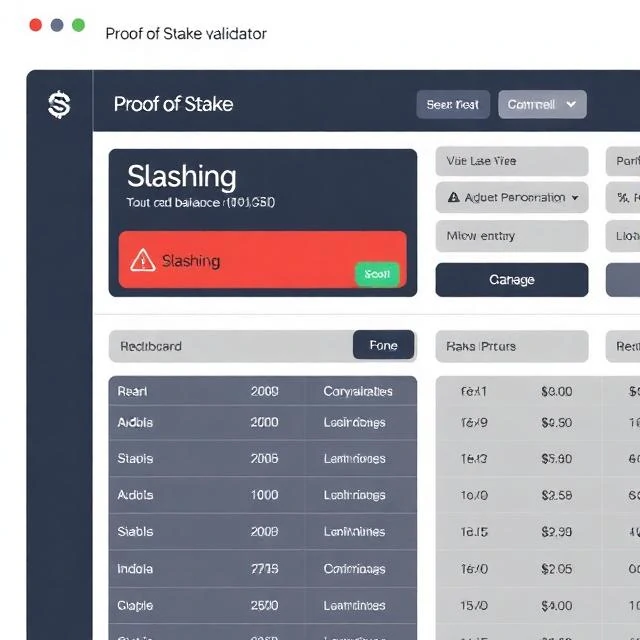
Slashing penalizes proof-of-stake validators for misbehavior. If a validator signs two conflicting blocks, goes offline for too long, or attacks the network, the protocol burns part of their staked coins. The penalty is automatic. No committee decides. The rules are in the code. Slashing is what makes proof of stake secure. Without it, validators could cheat with no cost. With it, cheating is expensive. A validator with millions of dollars staked has a strong incentive to follow the rules.
Slashing conditions vary by network. Ethereum slashes for double signing and surround voting. It also penalizes inactivity, though that is a separate mechanism. The penalty for double signing is at least 1 ETH, plus additional slashing proportional to the number of validators slashed around the same time. If many validators are slashed at once, the penalty escalates. That prevents a coordinated attack from wiping out only a small portion of stake. Delegators share the risk. If you delegate to a validator that gets slashed, your stake gets slashed too. Choose your validator carefully.
Slashing causes
- Double signing — voting for two conflicting blocks
- Surround voting — conflicting attestations
- Extended downtime — inactivity penalties
- Coordinated attacks — escalated penalties for mass misbehavior
Slashing is not punishment for its own sake. It is the cost of security. Honest validators never notice it. Dishonest ones lose their stake.
Comments
No comments yet. Be the first to share a thought.
Leave a comment