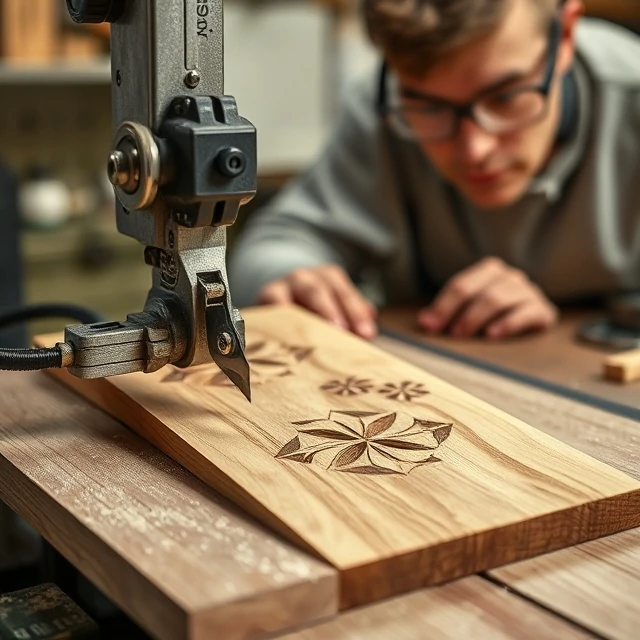
A scroll saw cuts intricate curves in thin wood and other soft materials. The blade is fine and short, held under tension between two arms. It moves up and down fast, and the work is guided into the blade by hand. Because the blade is thin, it can turn tight corners that a band saw cannot. The table tilts for angled cuts. Most scroll saws accept pinned or pinless blades. Pinless blades are thinner and allow finer work.
Scroll saws are quieter and less intimidating than table saws or routers. They are popular for fretwork, puzzles, ornaments, inlays, and lettering. The blade cuts on the downstroke, which pulls the work against the table. That makes the machine easier to control than a band saw. Speed is adjustable. Slow speeds suit plastic and metal. Faster speeds cut wood cleanly.
Materials and blades
- Skip-tooth blades — fast cutting, good for thick wood
- Reverse-tooth blades — clean top and bottom edges
- Spiral blades — cut in any direction without turning the work
- Metal-cutting blades — fine teeth for brass, copper, and aluminum
Let the blade do the cutting. Pushing too hard bends the blade, burns the wood, and breaks the fine teeth. Feed steadily and keep the work flat on the table.
Comments (2)
Leave a comment