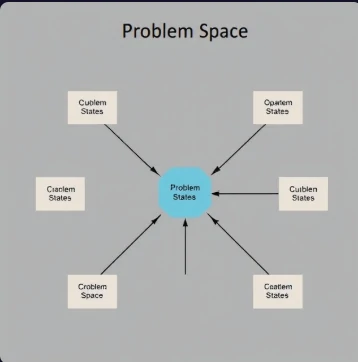
Every possible state of a puzzle and every legal move between states together constitute the problem space. It is the mental or formal representation of a problem that includes the initial state, the goal state, and the operators that transform one state into another.
Newell and Simon introduced the concept in their analysis of human problem solving. Search within the problem space can be exhaustive or guided by heuristics that reduce the number of paths considered. The size and structure of the space determine difficulty. Experts effectively prune the space by recognizing promising directions; novices often explore unproductively.
Well-defined problems have clearly specified spaces; ill-defined problems require the solver to construct the space itself. Understanding problem spaces helps in designing instruction, decision aids, and artificial intelligence search algorithms. The way a problem is framed sets the boundaries within which solutions can appear.
- Representation of states and operators in a problem
- Includes initial state, goal, and legal moves
- Search can be systematic or heuristic
- Expertise reduces effective search space
Comments
No comments yet. Be the first to share a thought.
Leave a comment