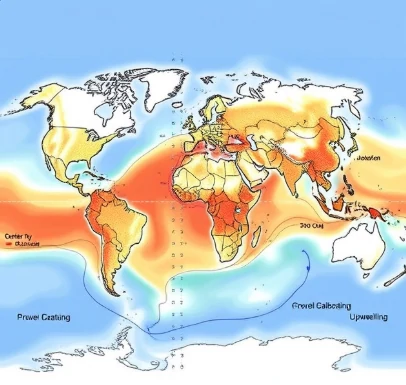
Density differences caused by temperature (thermo) and salinity (haline) drive a global-scale overturning of the ocean. Cold, salty water formed in polar regions sinks and spreads through the deep ocean, while slower upwelling returns water to the surface elsewhere. This thermohaline circulation, sometimes called the global conveyor belt, redistributes heat and carbon on timescales of centuries.
The North Atlantic is a key formation region for deep water; the Southern Ocean around Antarctica is another. The return flow toward the surface is distributed and still incompletely mapped. Changes in freshwater input from melting ice or altered precipitation could weaken the formation of dense water and thereby alter the circulation, with potential climate consequences especially for the North Atlantic region.
Evidence for past changes in thermohaline circulation comes from sediment records and ice cores. Modern observations rely on deep moorings, floats, and tracer measurements. Models of varying complexity simulate the circulation and its sensitivity to forcing. The system is slow but carries immense volumes of water and heat.
A water parcel that sinks in the Nordic Seas may take a thousand years to complete its circuit.
Comments
No comments yet. Be the first to share a thought.
Leave a comment