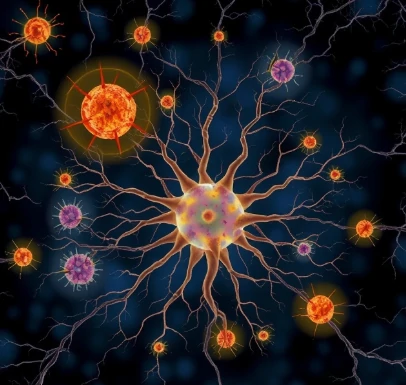
Neurons are not the only cells in the nervous system. A diverse population of glial cells surrounds, supports, and actively interacts with them. In the central nervous system the main types are astrocytes, oligodendrocytes, and microglia; in the periphery, Schwann cells perform analogous roles.
Glia regulate the chemical environment, form myelin, provide metabolic support, and defend against pathogens and injury. Far from passive, they respond to neural activity with calcium signals and can release transmitters that modulate synapses. During development they guide migrating neurons and help form synapses; in adulthood they participate in plasticity and in the response to disease.
Many neurological conditions involve glial dysfunction—demyelination, reactive gliosis, chronic inflammation. Research that once focused almost exclusively on neurons now recognizes glia as equal partners in both healthy function and pathology.
In some brain regions glial cells outnumber neurons by a substantial margin.
Comments
No comments yet. Be the first to share a thought.
Leave a comment