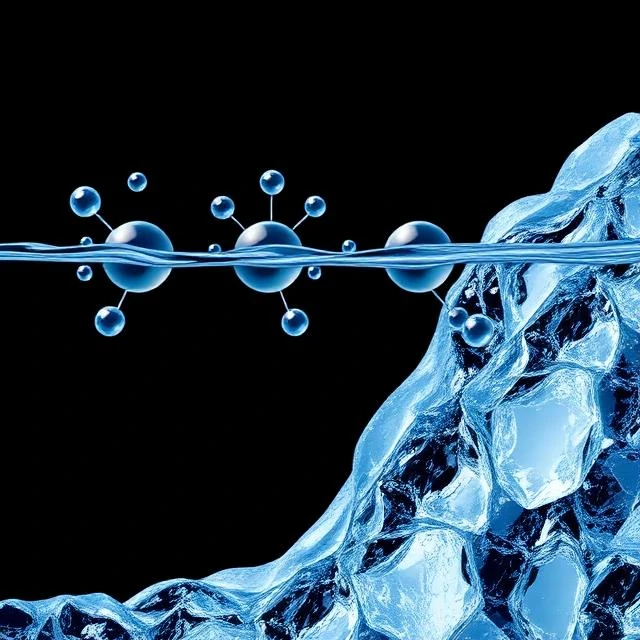
Water boils at 100 degrees Celsius. Hydrogen sulfide, a similar molecule, boils at minus 60. The difference is hydrogen bonding. A hydrogen bond is a weak attraction between a hydrogen atom bonded to a highly electronegative atom, like oxygen, nitrogen, or fluorine, and another electronegative atom. The hydrogen carries a partial positive charge, and the other atom carries a partial negative charge. The attraction is electrostatic.
Hydrogen bonds are weaker than covalent bonds, about 5 to 30 kilojoules per mole compared to hundreds for covalent bonds. But they are numerous and collectively strong. In water, each molecule can form up to four hydrogen bonds. That network is why water has a high boiling point, high surface tension, and high heat capacity. It is why ice floats, because the hydrogen-bonded lattice is less dense than liquid water.
Hydrogen bonds are essential in biology. They hold the two strands of DNA together. They stabilize the secondary structure of proteins, forming alpha helices and beta sheets. They determine how enzymes bind their substrates. They affect the solubility of drugs and the folding of RNA. Without hydrogen bonds, life as we know it would not exist.
Hydrogen bonds are not just a curiosity. They are a design principle. Chemists use them to build supramolecular assemblies, design drugs, and create materials with tunable properties. The bond is weak, but its effects are profound.
Comments
No comments yet. Be the first to share a thought.
Leave a comment