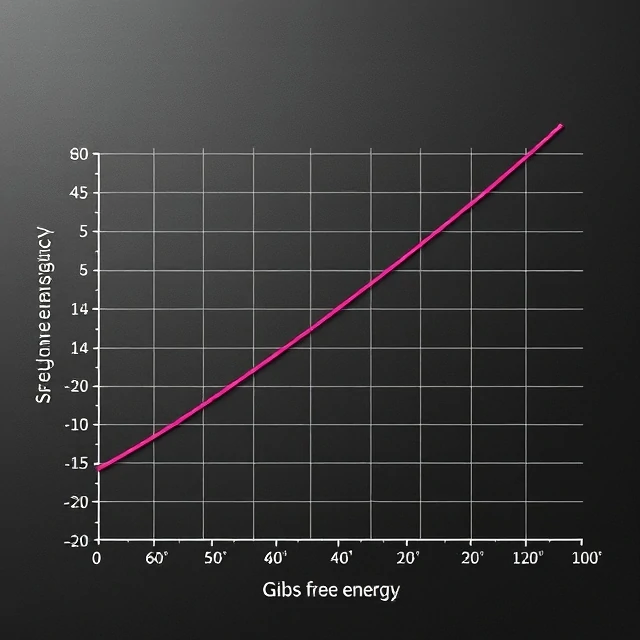
Will a reaction happen on its own? That is the question Gibbs free energy answers. It combines enthalpy and entropy into a single quantity that predicts spontaneity. The equation is delta G = delta H minus T delta S. If delta G is negative, the reaction is spontaneous. If it is positive, the reaction is non-spontaneous. If it is zero, the system is at equilibrium. Gibbs free energy is the thermodynamic driving force.
The concept was developed by Josiah Willard Gibbs in the 1870s. He showed that at constant temperature and pressure, the direction of spontaneous change is toward lower free energy. The free energy is the energy available to do useful work. Some of the total energy is tied up in entropy and cannot be used. The rest is free.
Gibbs free energy explains many observations. An exothermic reaction with increasing entropy is always spontaneous. An endothermic reaction with decreasing entropy is never spontaneous. An exothermic reaction with decreasing entropy is spontaneous at low temperatures. An endothermic reaction with increasing entropy is spontaneous at high temperatures. The temperature dependence comes from the T delta S term.
Gibbs free energy is used to predict reaction feasibility, calculate equilibrium constants, and design chemical processes. It is also used in biology to understand metabolism. ATP hydrolysis has a negative delta G, which is why it drives cellular work. The field of bioenergetics is built on Gibbs free energy.
Comments
No comments yet. Be the first to share a thought.
Leave a comment