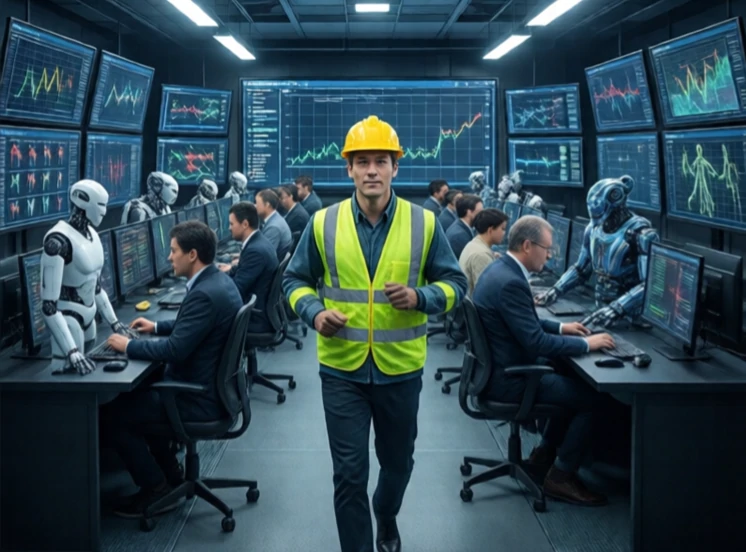
Simulation models robot behavior in a virtual environment. It uses physics engines to calculate how objects move, collide, and respond to forces. Engineers test control algorithms, motion plans, and machine learning policies in simulation before running them on real hardware.
Simulation saves time and money. A robot that crashes in simulation costs nothing. A robot that crashes on hardware costs money and downtime. Simulation also lets engineers test scenarios that are too dangerous or too rare to reproduce in reality: a sensor failure, a human stepping into the robot's path, a power loss. They can run thousands of tests in parallel on a cluster.
Simulation tools
- Gazebo: open-source, ROS integration.
- MuJoCo: fast physics, reinforcement learning.
- Isaac Sim: NVIDIA, GPU-accelerated, photorealistic.
- PyBullet: Python, easy to use, research.
- Webots: educational, cross-platform.
The main limitation is the sim-to-real gap. Simulation is never perfect. Friction models are approximate. Sensor noise is simplified. Contact dynamics are hard to simulate accurately. A policy that works in simulation may fail on hardware. Engineers use domain randomization to make policies robust. They randomize mass, friction, sensor noise, and lighting during training. The real world becomes just another variation. Some systems use system identification to tune the simulation to match the real robot. Others use residual learning, where the real robot corrects the simulation's errors. Simulation is not a replacement for real-world testing. It is a filter that catches most problems before they reach hardware. The remaining problems are the ones that matter.
Comments
No comments yet. Be the first to share a thought.
Leave a comment