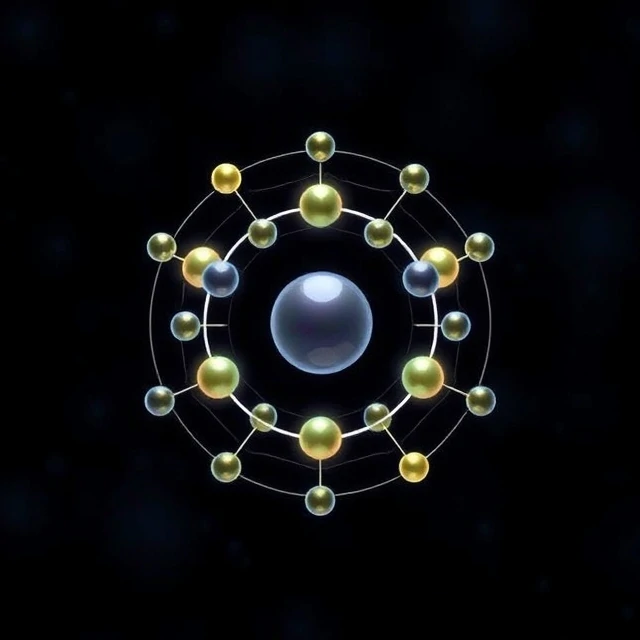
Fermions are the particles that make up matter. Electrons, protons, neutrons, and quarks are all fermions. They obey the Pauli exclusion principle, which says that no two fermions can occupy the same quantum state. That rule is why atoms have structure, why electrons fill shells in a specific order, and why matter does not collapse into a single dense blob. Fermions have half-integer spin, like 1/2 or 3/2. Bosons, by contrast, have integer spin and can pile into the same state.
The exclusion principle has profound consequences. It is why white dwarf stars and neutron stars do not collapse under their own gravity. The electrons or neutrons resist compression because they cannot all occupy the same state. That resistance is called degeneracy pressure. Fermions come in two types: quarks, which feel the strong force, and leptons, which do not. Quarks combine to form protons and neutrons. Leptons include electrons, muons, and neutrinos. Every fermion has an antiparticle with opposite charge. The word fermion honors Enrico Fermi, who developed the statistics that describe them.
Fermion facts
- Matter particles. Electrons, protons, neutrons, quarks.
- Spin. Half-integer, like 1/2.
- Exclusion principle. No two in the same quantum state.
- Degeneracy pressure. Supports white dwarfs and neutron stars.
- Types. Quarks and leptons.
Fermions are not the same as bosons. Fermions make up matter. Bosons carry forces.
Comments
No comments yet. Be the first to share a thought.
Leave a comment