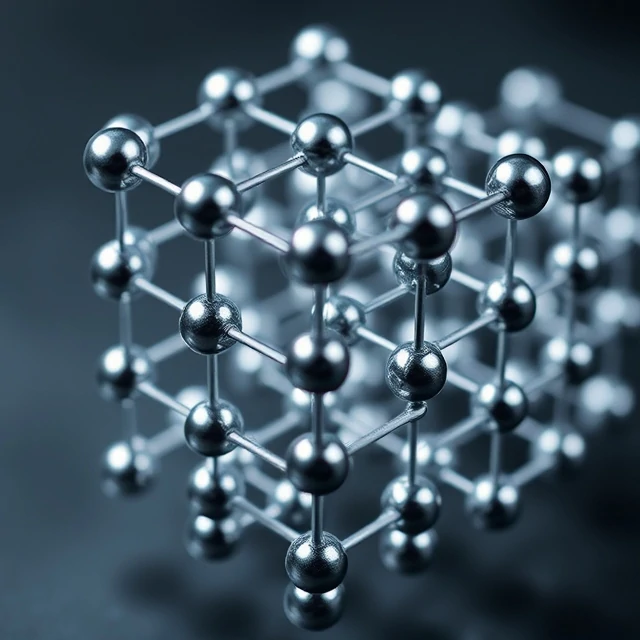
Condensed matter physics studies the physical properties of matter in its condensed phases: solids and liquids. It is the largest branch of physics by number of researchers, and it has produced some of the most consequential technologies of the modern world. Semiconductors, superconductors, liquid crystals, and magnetic materials all fall within its scope. The field asks how atoms and electrons organize themselves, and how that organization produces the properties we observe.
The central insight is that collective behavior matters. A single electron is simple. A trillion electrons interacting with each other and with a lattice of atoms can produce phenomena that no single particle exhibits. Superconductivity, where current flows with zero resistance, is one example. Magnetism is another. Topological insulators, which conduct on their surface but not through their bulk, are a more recent discovery. Condensed matter physics also studies phase transitions: how a material changes from one phase to another, and what happens at the critical point. The field overlaps with materials science, chemistry, and engineering, and it has driven advances in computing, energy, and medicine.
Topics in condensed matter
- Semiconductors. Materials that conduct under certain conditions.
- Superconductors. Zero resistance below a critical temperature.
- Magnetism. How spins align in materials.
- Phase transitions. Changes between solid, liquid, and other states.
- Topological materials. Conduct on surfaces, insulate inside.
Condensed matter physics is not just about solids. It also studies soft matter, including polymers, gels, and liquid crystals.
Comments
No comments yet. Be the first to share a thought.
Leave a comment