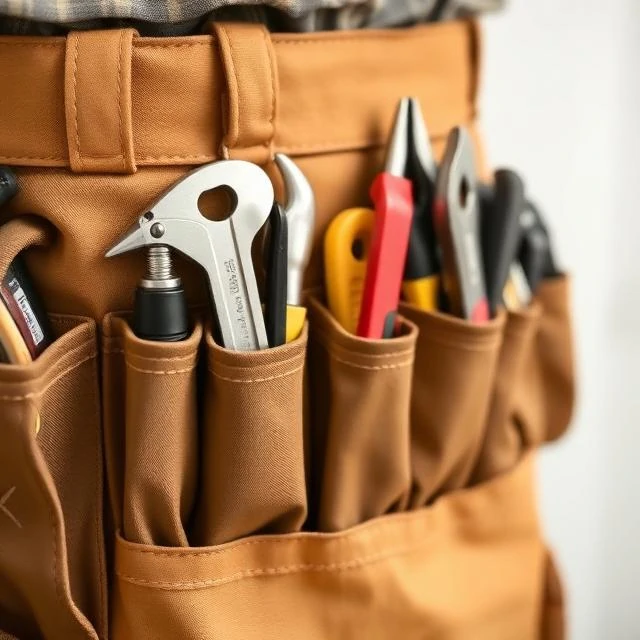
A tool belt carries hand tools on site. It is a belt with pockets, loops, and holders. It is worn around the waist or over the shoulder. It keeps the tools close at hand. It saves time. It reduces trips to the toolbox. It also distributes the weight of the tools across the hips and shoulders. A good tool belt is balanced and comfortable. A bad one is heavy and awkward. The tool belt is a worker's office. It is where the tools live.
Tool belts come in several types. A carpenter's belt has pockets for a hammer, a tape, a square, and pencils. An electrician's belt has loops for pliers, screwdrivers, and a wire stripper. A framer's belt has large pockets for nails and a hammer loop. A finish belt is smaller and lighter, for trim work. A suspender-style belt has shoulder straps that transfer the weight. A pouch is a small bag that clips to the belt. Each trade has its own configuration. The belt is customized to the work.
Tool belts must be maintained. The leather must be oiled. The stitching must be inspected. The pockets must be cleaned. A worn belt can drop a tool. A dropped tool can injure someone below. The belt must be loaded properly. Heavy tools go on the back. Frequently used tools go on the front. The belt must not be overloaded. A heavy belt causes back strain. The tool belt is a simple accessory. It is also a professional statement. It says: I am ready to work. It says: I know my trade. It says: I am a craftsman.
Comments
No comments yet. Be the first to share a thought.
Leave a comment