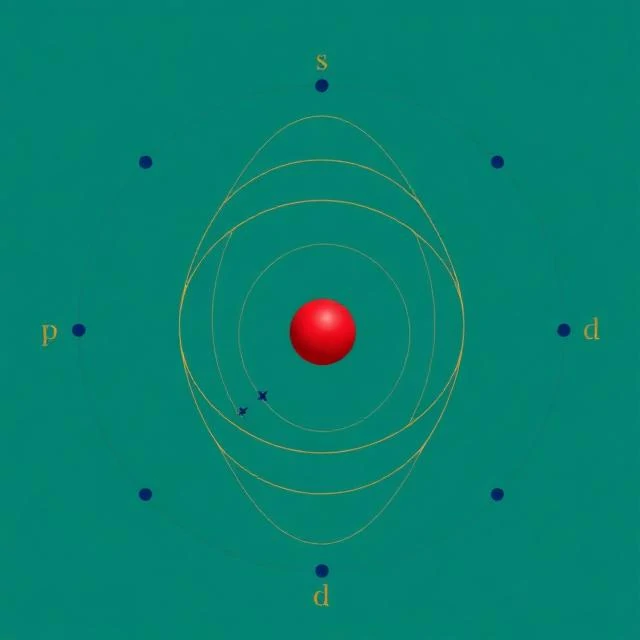
Electrons do not orbit the nucleus like planets around the sun. They exist in orbitals, regions of space where the electron is most likely to be found. An orbital is a probability distribution, not a path. The shape of an orbital depends on the energy level and sublevel of the electron. The s orbital is spherical. The p orbitals are dumbbell-shaped. The d and f orbitals are more complex.
Each orbital holds a maximum of two electrons with opposite spins. The Pauli exclusion principle forbids two electrons in the same orbital from having the same spin. The number of orbitals in a sublevel determines how many electrons it can hold. An s sublevel has one orbital and holds two electrons. A p sublevel has three orbitals and holds six. A d sublevel has five orbitals and holds ten. An f sublevel has seven orbitals and holds fourteen.
The shapes of orbitals determine how atoms bond and how molecules form. The overlap of orbitals creates covalent bonds. The orientation of orbitals determines molecular geometry. The energy of orbitals determines the colors of light that atoms absorb and emit. Spectroscopy is the study of these transitions.
The concept of the orbital comes from quantum mechanics. It was developed by Erwin Schrödinger, Werner Heisenberg, and others in the 1920s. It replaced the Bohr model of fixed orbits. The orbital is a mathematical function, but it has physical meaning. It describes where the electron is likely to be.
Comments
No comments yet. Be the first to share a thought.
Leave a comment