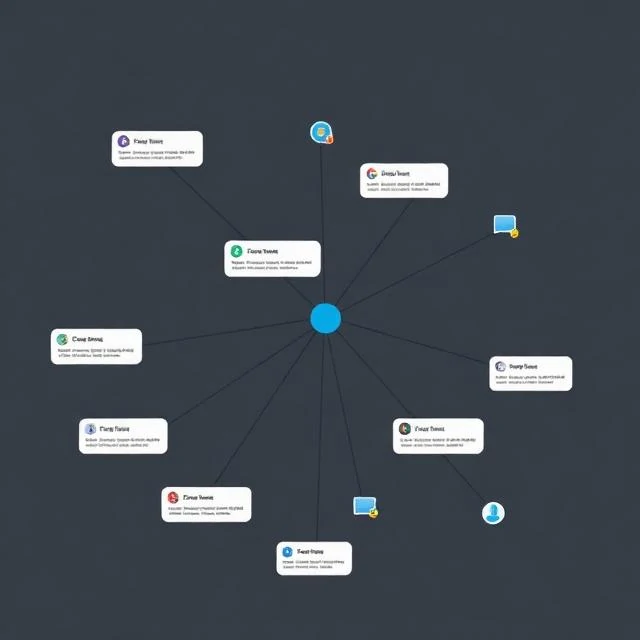
Not all data fits in a grid. Social networks, molecules, and road maps are graphs, with nodes and edges rather than pixels or sequences. Graph neural networks operate directly on this structure, passing messages between connected nodes to learn representations.
The core operation is message passing. Each node aggregates information from its neighbours, updates its own representation, and repeats for several rounds. After enough layers, each node encodes information from its local neighbourhood.
Common graph tasks
- Node classification
- Link prediction
- Graph classification
- Recommending connections
- Predicting molecular properties
Scaling is a challenge. Large graphs have millions of nodes and edges, and full-batch training does not fit in memory. Sampling techniques and mini-batch methods make training feasible, at some cost in accuracy.
Comments
No comments yet. Be the first to share a thought.
Leave a comment