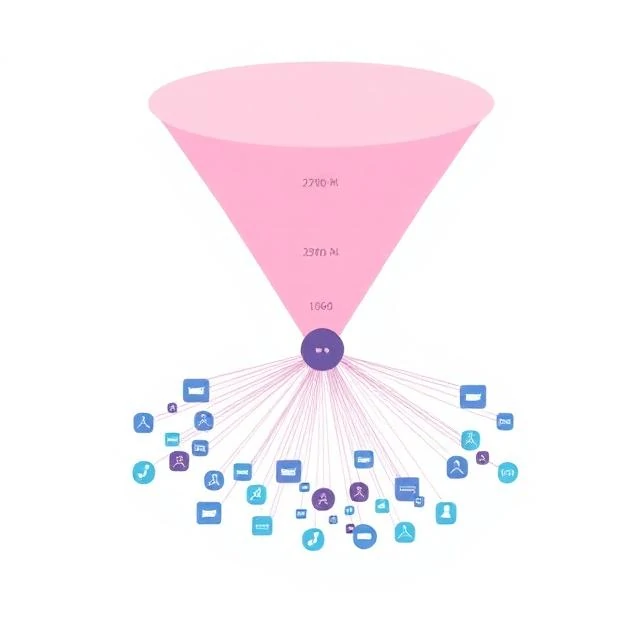
Squeeze data through a narrow opening and force it to reconstruct. An autoencoder learns by compressing input into a compact representation, then rebuilding the original from that bottleneck. The network cannot simply copy. It has to capture the structure that matters.
Two halves do the work. The encoder maps input to a latent vector. The decoder maps that vector back to the original space. Training minimizes reconstruction error, often measured in mean squared error or cross-entropy.
Common uses
- Dimensionality reduction as a nonlinear alternative to PCA
- Denoising, where the network removes corruption
- Anomaly detection by measuring reconstruction error
- Pretraining for downstream tasks
Variants extend the idea. Variational autoencoders impose a probabilistic structure on the latent space, which lets them generate new samples. Sparse autoencoders add penalties to encourage compact codes.
Comments (2)
Leave a comment