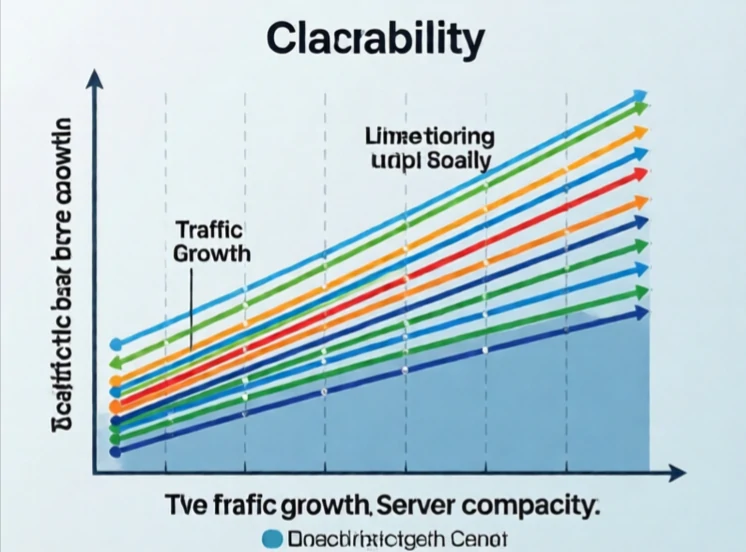
A website handles a thousand users. Then a million. Does it crash? Scalability is the ability of a system to handle growing amounts of work. It can grow by adding resources (horizontal scaling) or by making existing resources more powerful (vertical scaling). A scalable system does not break when demand rises.
Vertical scaling is simpler. Add more RAM, a faster CPU, a bigger disk. But there are limits. You cannot add infinite RAM. Horizontal scaling is harder. Add more machines and distribute the load. It requires load balancers, distributed databases, and stateless services. But it can scale almost without limit.
Scaling strategies
- Horizontal: add more servers
- Vertical: upgrade existing servers
- Load balancing: distribute traffic
- Caching: reduce repeated work
- Sharding: split data across machines
Scalability is not just about hardware. It is about architecture. A poorly designed system will not scale no matter how many servers you throw at it. A well-designed system can grow from a startup to a global platform. Design decisions made early determine how far you can go.
Comments
No comments yet. Be the first to share a thought.
Leave a comment