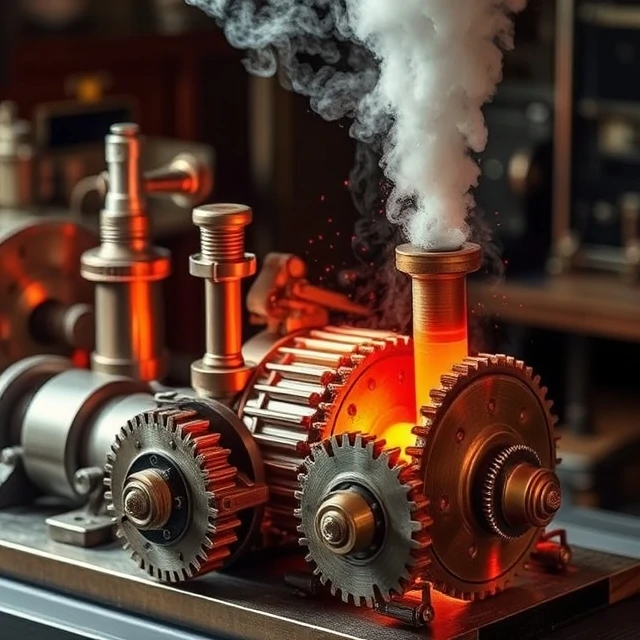
Thermodynamics is the study of energy, heat, and work in systems. It began in the 19th century, driven by the need to understand steam engines. It has since become one of the most fundamental branches of physics. Thermodynamics is built on four laws. The zeroth law defines temperature. The first law is conservation of energy. The second law says entropy tends to increase. The third law says absolute zero cannot be reached. Together, these laws describe how energy moves and changes in physical systems.
Thermodynamics is not just about engines. It applies to chemistry, biology, geology, and cosmology. It explains why heat flows from hot to cold, why perpetual motion machines are impossible, and why the universe tends toward disorder. It is used to design power plants, refrigerators, and air conditioners. It is used to understand the metabolism of living organisms. It is used to study the early universe, where temperatures were extreme. Thermodynamics is a macroscopic theory. It describes systems in terms of pressure, volume, temperature, and entropy, without reference to individual particles. Statistical mechanics connects those macroscopic quantities to the microscopic behavior of atoms and molecules.
Laws of thermodynamics
- Zeroth. Defines temperature.
- First. Energy is conserved.
- Second. Entropy tends to increase.
- Third. Absolute zero is unattainable.
Thermodynamics is not the same as statistical mechanics. Thermodynamics is macroscopic. Statistical mechanics is microscopic.
Comments
No comments yet. Be the first to share a thought.
Leave a comment