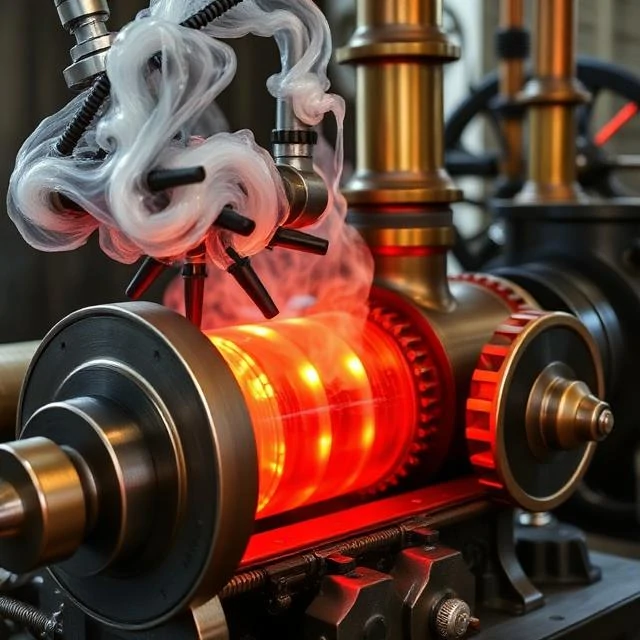
A steam engine converts heat into work. A battery converts chemical energy into electricity. A refrigerator moves heat from cold to hot. Thermodynamics studies these transformations. It is the branch of physics and chemistry that deals with energy, heat, work, and entropy. It does not care about the details of molecules. It cares about the big picture: what energy is available, what direction a process will go, and how efficient it can be.
Four laws frame the field. The zeroth law defines temperature and thermal equilibrium. The first law states that energy is conserved; it can change form but not be created or destroyed. The second law states that the total entropy of an isolated system always increases; heat flows spontaneously from hot to cold. The third law states that the entropy of a perfect crystal at absolute zero is zero. These laws are empirical. They have never been violated.
Thermodynamics has many applications. It designs engines, power plants, and refrigeration systems. It predicts whether a chemical reaction will occur and how much heat it will release or absorb. It explains why some processes are spontaneous and others are not. It is essential in chemistry, physics, engineering, and biology.
The field was developed in the 19th century by Sadi Carnot, James Prescott Joule, Rudolf Clausius, and William Thomson. They were trying to understand steam engines. They ended up with a framework that applies to everything from black holes to living cells.
Comments
No comments yet. Be the first to share a thought.
Leave a comment