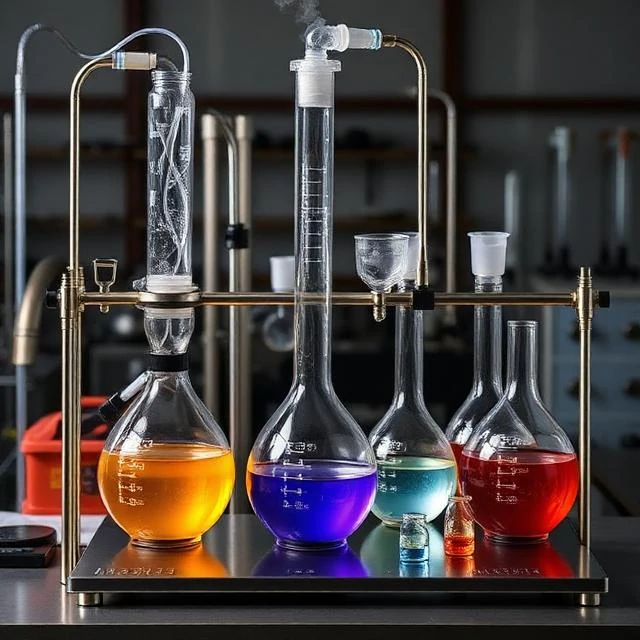
Crude oil is a mixture of hundreds of hydrocarbons. Refineries separate them by distillation. The oil is heated, and the components vaporize at different temperatures. The vapors rise through a fractionating column, condensing at different heights. Light gases come off at the top. Gasoline, kerosene, diesel, and heavy fuel oil come off at lower levels. Asphalt remains at the bottom. Distillation separates mixtures based on differences in boiling points.
The process has two main steps. Vaporization converts the more volatile component into a gas. Condensation converts the gas back into a liquid. The apparatus varies. Simple distillation separates a volatile liquid from a nonvolatile impurity, like purifying water from salt. Fractional distillation separates multiple components with different boiling points, like separating ethanol and water. Vacuum distillation lowers the pressure, which lowers boiling points, allowing heat-sensitive compounds to be distilled without decomposition.
Distillation is used in many industries. Petroleum refining, alcohol production, perfume manufacturing, and chemical purification all rely on it. It is also used in desalination, where seawater is distilled to produce fresh water. The energy cost is high because vaporization requires heat, but the separation is effective.
The theoretical basis is Raoult's law and Dalton's law. The vapor above a mixture is richer in the more volatile component. By collecting and condensing the vapor, the components are separated. Repeated vaporization and condensation cycles increase purity.
Comments
No comments yet. Be the first to share a thought.
Leave a comment