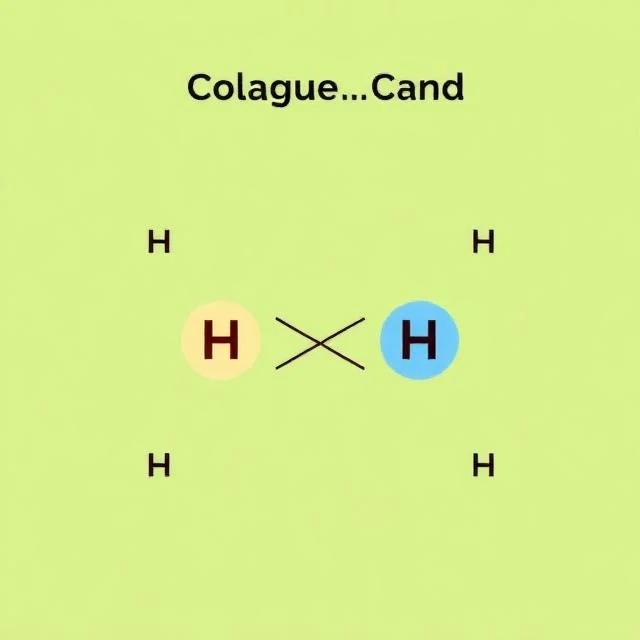
Two hydrogen atoms each have one electron. They share those electrons to form a hydrogen molecule. The shared pair holds the atoms together. That is a covalent bond, a bond formed by the sharing of electron pairs between atoms. It is the most common type of bond in organic chemistry and in biology. Water, proteins, DNA, and fats are all held together by covalent bonds.
Covalent bonds can be single, double, or triple. A single bond shares one pair of electrons. A double bond shares two pairs. A triple bond shares three pairs. The more pairs shared, the stronger and shorter the bond. Ethene has a carbon-carbon double bond. Ethyne has a triple bond. Nitrogen gas has a triple bond, which is why it is so unreactive.
Covalent bonds can be polar or nonpolar. In a nonpolar bond, the electrons are shared equally. In a polar bond, one atom attracts the electrons more strongly, creating partial positive and negative charges. The difference in electronegativity determines the polarity. Polar bonds make molecules polar, which affects solubility, boiling point, and reactivity. Water is polar, which is why it dissolves salts and sugars but not oils.
Covalent bonds are not always simple two-center, two-electron bonds. Some molecules have delocalized electrons, where the electrons are shared over multiple atoms. Benzene is the classic example. The delocalization stabilizes the molecule and gives it unique properties.
Comments (2)
Leave a comment