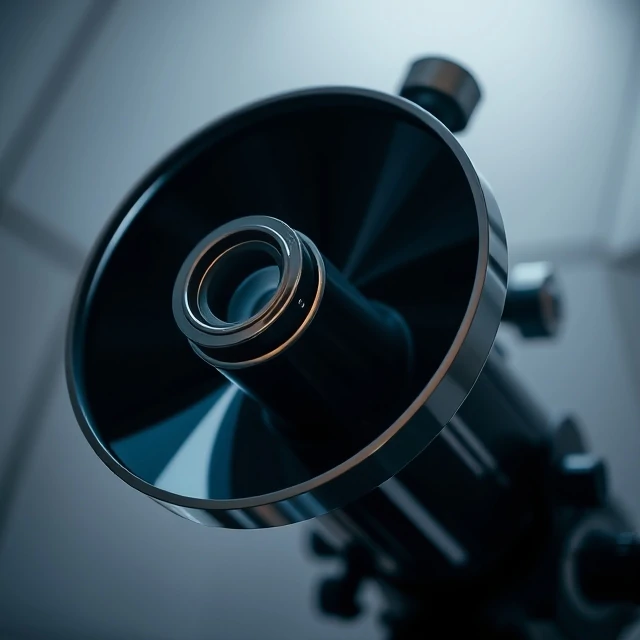
Isaac Newton built the first reflecting telescope in 1668. Instead of using a lens to focus light, he used a curved mirror. The design solved a problem that had plagued refracting telescopes: chromatic aberration. Lenses bend different colors of light by different amounts, producing rainbow fringes around bright objects. Mirrors reflect all wavelengths equally, so the image stays sharp.
A reflecting telescope uses a primary mirror to gather light and focus it. In the Newtonian design, a small flat mirror near the top reflects the light out the side to an eyepiece. In the Cassegrain design, a secondary mirror reflects the light back through a hole in the primary mirror. Other designs, like Ritchey-Chretien and Gregorian, use different mirror arrangements for different purposes.
Mirrors can be made much larger than lenses, because a mirror can be supported from behind. That is why the largest telescopes in the world are reflectors. The James Webb Space Telescope has a 6.5-meter segmented mirror. The Extremely Large Telescope under construction in Chile will have a 39-meter mirror. These instruments gather far more light than any lens could.
Newton's design is still used today, though modern telescopes are far more sophisticated. The principle is the same: a curved mirror, a focus, and an image of the cosmos.
Comments
No comments yet. Be the first to share a thought.
Leave a comment