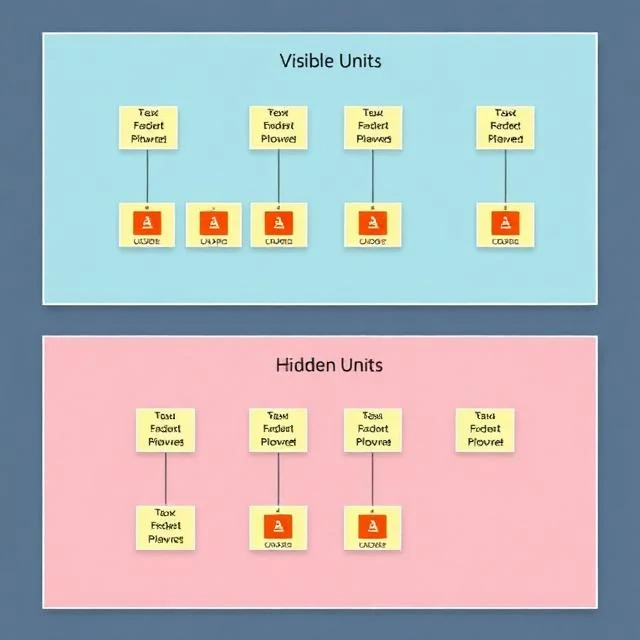
Two layers, no connections within a layer. A restricted Boltzmann machine consists of visible units and hidden units, with connections only between the two groups. That restriction makes training tractable through contrastive divergence.
The model learns a probability distribution over visible units. Hidden units capture latent features. Once trained, the network can generate samples by running Gibbs sampling between the layers.
Key properties
- Bipartite graph structure
- Energy-based probabilistic model
- Contrastive divergence training
- Used as building blocks in deep belief networks
RBMs were central to the deep learning revival in 2006, when stacking them enabled effective pretraining. Modern architectures like VAEs and diffusion models have largely replaced them, but the ideas still appear in energy-based modelling research.
Comments (2)
Leave a comment